

Did you know that over 80% of Amazon sales go through the Buy Box? If you’re not winning it, you’re essentially invisible to the majority of shoppers. After 10 years of watching Amazon’s Buy Box algorithm evolve, one thing has remained true: most new sellers misunderstand what Amazon is really evaluating behind the scenes.
You don’t win the Buy Box simply by lowering your price. Amazon scores every offer using a mix of fulfillment speed, performance metrics, shipping history, and regional inventory strength. Once you understand how those signals work together, the Buy Box becomes much more predictable.
In this post, we’ll break down exactly how to win the Buy Box on Amazon. You’ll learn the key factors Amazon considers, common mistakes to avoid, and some quick tips to improve your chances. By the end, you’ll know exactly what it takes to consistently win the Buy Box and increase your sales. Let’s get started.
What Is the Amazon Buy Box (And Why It Matters for Arbitrage Sellers)
The Amazon Buy Box, or Featured Offer, is the section on a product page where shoppers can click “Add to Cart” or “Buy Now.” On desktop, it sits on the right side of the page, and on mobile, it appears near the top. When a customer clicks on one of those buttons, the order goes to the seller that Amazon has chosen as the current Buy Box winner.
For arbitrage sellers, competing with other sellers on the same listing, Amazon reviews all the eligible offers and picks one for the Buy Box based on several factors like price, shipping speed, fulfillment method, and account performance. That choice can change many times per day based on price adjustments, updated inventory levels, and the shopper’s geographic location.
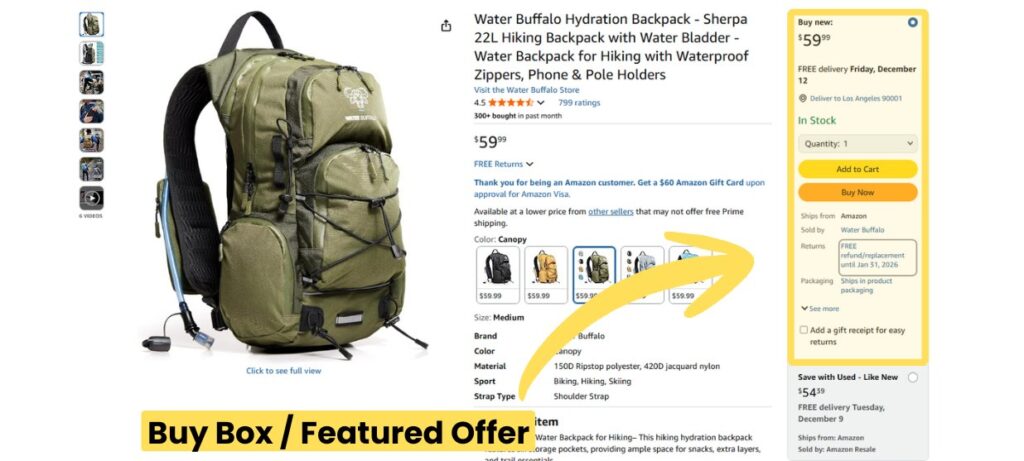
Winning the Buy Box is important because it’s where most of Amazon’s sales come from. Rough estimates suggest that up to 80-90 percent of all sales are made through the Featured Offer. For online and retail arbitrage sellers, this often means you either hold the Buy Box and make consistent sales, or you sit on inventory that barely moves.
This is also why so many experienced sellers watch their Buy Box share just as closely as they watch their profit margins.
Every seller on Amazon relies on the Buy Box for one reason or another. Even private-label sellers, who don’t have to worry about competing with other sellers on their listing, depend on keeping the Buy Box active so shoppers can easily purchase their products with a single click. If they don’t meet the requirements, the Featured Offer can be removed, and their conversions can take a major hit.
How the Buy Box Algorithm Works in 2026
Many new sellers think the Buy Box is just a price battle, where the lowest price always wins, but the real system behind it is a lot more complicated.
Amazon starts by deciding which sellers on a listing qualify for the Featured Offer spot, then it ranks those eligible offers every time a shopper loads the page. This means that the Buy Box can shift dozens of times throughout the day based on constant price changes, inventory updates, and the shopper’s location.
The first step is an eligibility check. Amazon checks that you meet the requirements: a Professional Seller Plan, new product condition, in-stock, and acceptable seller metrics. If anything fails that list, you’re immediately removed from consideration.
If you pass, Amazon moves into what is essentially a live scorecard. Instead of choosing a single winner for hours at a time, Amazon compares all eligible offers every time the page loads. The algorithm weighs several metrics (which we’ll discuss later), but the basic idea is simple: The offer that is the most beneficial for that specific shopper gets the Buy Box at that moment.
If you win the Buy Box in one case, it doesn’t mean that you will win it for the next one. Prices are constantly updated, and new offers are always being added; the Buy Box rotates constantly. If you have a great offer, you might be able to hold it for 60-80% of the time, but other times you may only pick up a few percentage points.
Amazon Buy Box Eligibility Requirements
Before Amazon decides which seller becomes the Featured Offer, it checks whether you are even allowed to compete. These requirements are separate from ranking factors like price or shipping speed, and if you don’t meet them, the Buy Box won’t consider your offer at all.
Luckily, most of these requirements are straightforward, and there is a good chance you already meet all or most of them. These are:
- Professional Seller Account: Only sellers using Amazon’s $39.99/month seller plan are eligible for the Buy Box. If you are using an Individual plan, your products will be excluded from Buy Box eligibility.
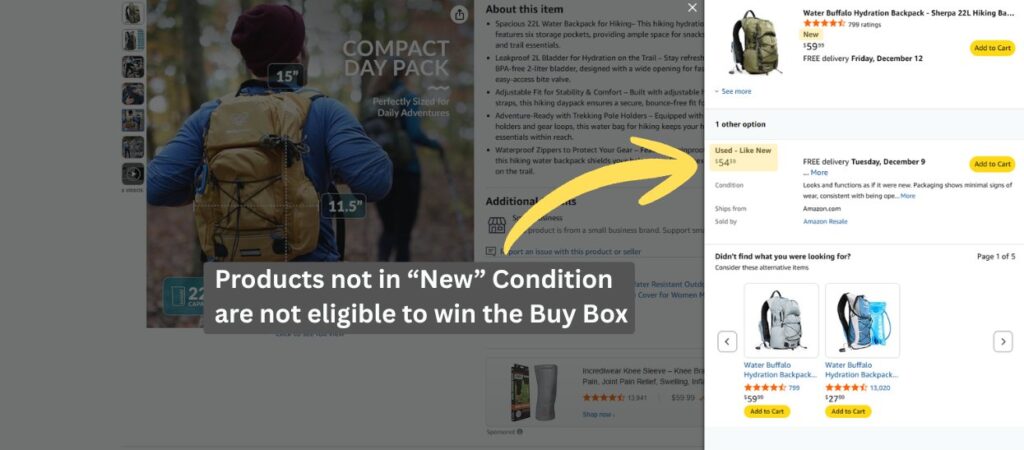
- “New” Condition Products: Only products that are listed as “new” are eligible. Secondhand or used products will not be chosen as the Featured Offer.
- In-Stock: This one should be obvious, but your product must currently be in stock in order to win the Buy Box. If you run out of inventory, your Buy Box eligibility pauses until you restock.
- Account Health: If your seller metrics are very poor, you may not be eligible to win the Buy Box. This includes factors like Order Defect Rate, Late-Shipment Rate, or Order Cancellation Rate. This can be a major issue since poor account health can harm not just one listing, but your entire catalog at once.
These four requirements are your first step to winning the Buy Box. If you don’t meet them, it won’t matter how good your price is or how fast you can ship each item.
The Key Factors Amazon Uses to Pick a Buy Box Winner
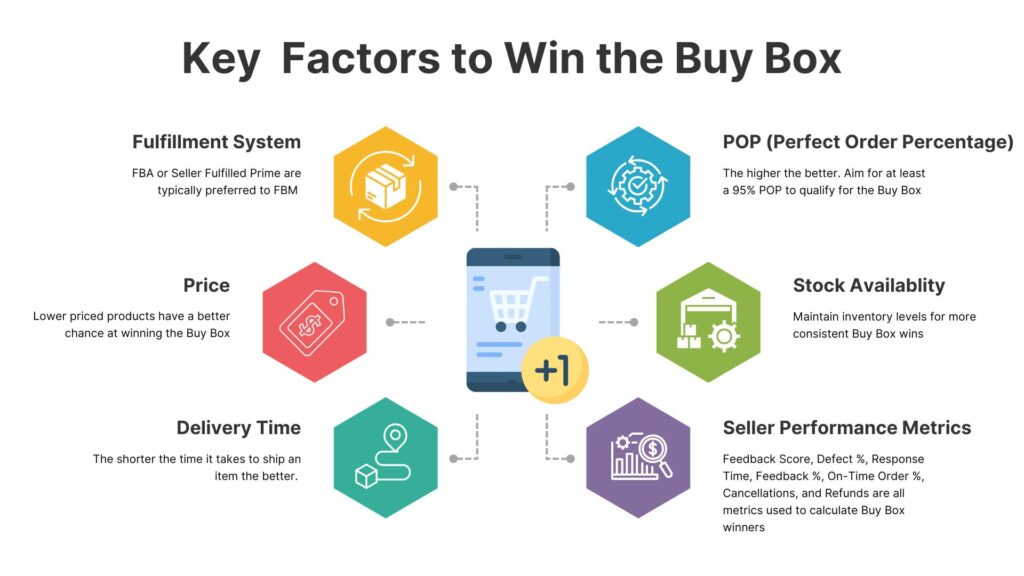
Once a seller meets the basic eligibility requirements, Amazon starts comparing all active offers to determine which one should be featured in the Buy Box. This is where the real competition happens. The system evaluates several core variables at the same time, and each one affects your chances in a different way. These aren’t guesses or vague ideas — Amazon has used the same core framework for years, and while the weighting changes over time, the underlying factors remain consistent.
Below are the main elements Amazon evaluates when deciding which seller gets the Buy Box in 2026.
Fulfillment Method (FBA, SFP, or FBM)
Fulfillment is still the most important Buy Box factor in 2026. Amazon wants customers to receive their orders quickly and without any issues, and your choice of fulfillment method directly impacts that experience. This is why FBA sellers typically get such a big advantage when it comes to competing for the Featured Offer. Amazon trusts and prefers its own logistics network and 1-2 day Prime Shipping, so FBA tends to get preferential treatment.
That’s why two sellers with identical products and prices can often see wildly different Buy Box shares depending on their fulfillment method. With all else equal, the FBA seller will have a much easier time consistently winning the Buy Box than an FBM seller responsible for their own shipping.
Using FBA also impacts a lot of the other factors we’ll discuss later on. Fast shipping speeds, on-time delivery, and reliable tracking naturally improve your account health, which also helps to improve your chances.
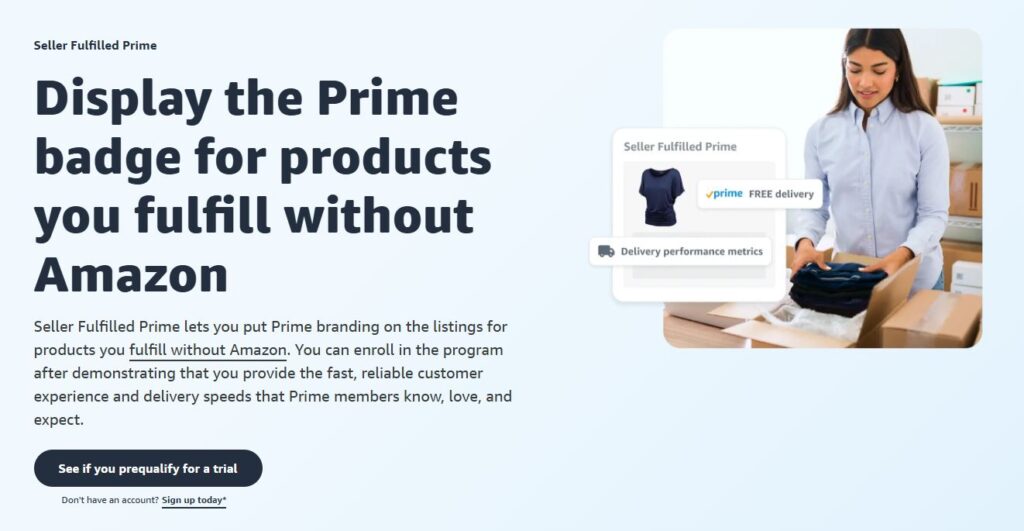
FBM sellers can still win the Buy Box, but will typically need to price lower than FBA sellers and also have excellent seller metrics. You also have the option of signing up for Seller Fulfilled Prime or SFP. SFP gives an FBM seller many of the same benefits as FBA, including a Prime shipping badge. There are very strict requirements you’ll need to meet, but if you succeed, you are able to compete with FBA sellers on an even playing field.
Product Price
Price is the second most important factor after fulfillment method, with Amazon preferring lower-priced products for the Featured Offer. It’s important to point out that Amazon looks at the landed price, which includes both the item price and the shipping cost. If two offers are otherwise equal, the product with the better landed price is typically the winner.
However, one of the biggest mistakes a lot of sellers make is pricing too low. A price that undercuts the market by too much can trigger Amazon’s Fair Pricing Policy, which may remove you from the Buy Box competition entirely. This is because Amazon treats prices far below the market average as unrealistic and potentially harmful to customers, in other words, a scam.
Shipping Speed and Delivery
In 2026, fast shipping is an expectation for most customers. Orders that arrive late or offers with long delivery estimates hurt customer experience and reduce your chances of becoming the Featured Offer.
If you’re already using FBA as your fulfillment method, as we discussed in the fulfillment section, you’ve already got this one covered. This factor plays a larger role for FBM sellers, where shipping times can vary a lot depending on the carrier you choose and the shipping speed you provide shoppers.
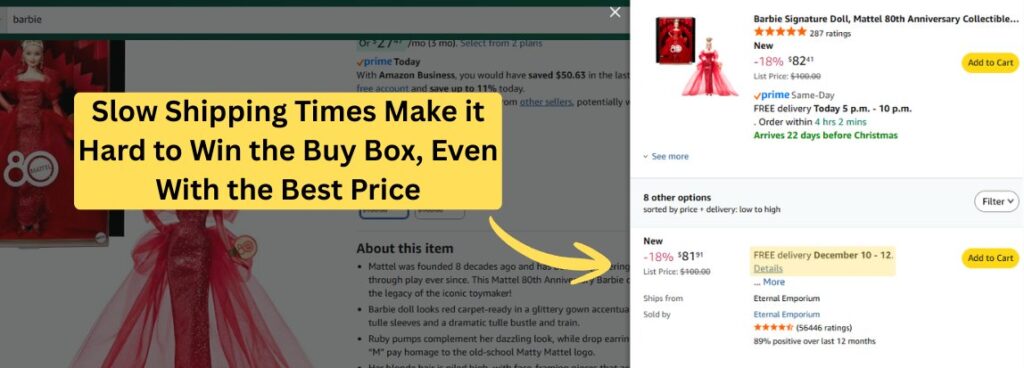
Amazon tracks metrics like Valid Tracking Rate, on-time delivery percentage, and handling time accuracy for all sellers. When these numbers drop, so do your chances of winning the Buy Box. As an FBM seller, always try to choose reliable carriers with accurate tracking data and reasonable delivery schedules.
Inventory Strength and Regional Availability
When it comes to inventory, avoiding stockouts is just one piece of the puzzle. Amazon also considers how well your inventory is placed across its fulfillment network. When your FBA stock is spread across multiple fulfillment centers around the country, this means that your offer can ship quickly to more regions, which increases your Buy Box chances.
For example, suppose all of my inventory is located in a fulfillment center in California. In that case, I have a very low chance of being the featured offer for any orders coming from the East Coast. Amazon will try to find sellers with inventory located in fulfillment centers nearest to each shopper in order to guarantee faster delivery times.
For most arbitrage sellers, this one can be a bit tricky. Since we tend to work with low quantities of inventory at a time, it is common for Amazon to only distribute to one or two fulfillment centers. For private label sellers, always try to avoid low inventory levels so Amazon can optimize your product distribution nationwide.
Seller Performance Metrics
Amazon is constantly tracking your account health and using it to help determine if you are a suitable contender for the Buy Box. Several metrics are considered, and these include:
- Order Defect Rate – The percentage of orders with serious problems, like A-to-Z claims, chargebacks, or 1-star feedback.
- Late Shipment Rate – How often you confirm orders as shipped after the expected ship date.
- Cancellation Rate – The percentage of customer orders you cancel after they’ve already been placed.
- Valid Tracking Rate – The percentage of your shipments that include working tracking numbers.
- Customer Feedback and Returns – How often buyers leave negative reviews or return items, and the reasons they give when they do.
You don’t need to have perfect numbers to be considered, but they should be at or around the suggested targets for each one. I highly recommend checking out your stats in Seller Central by finding the “Performance” tab in the main menu and then clicking on “Account Health.”
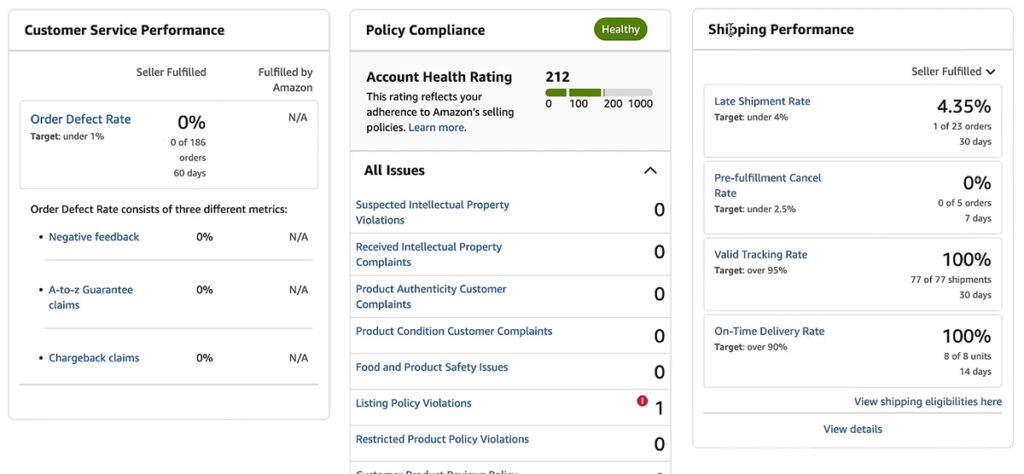
For both retail and online arbitrage sellers, customer feedback and return rates are crucial. Retail packaging damage, mismatched product variations, and product condition complaints can really hurt your ODR, which in turn can cost you the Buy Box even when your pricing and shipping speed are in check.
This is one factor where long-term sellers have a clear advantage over beginners. Amazon rewards proven reliability, and sellers with healthy seller metrics can often win the Buy Box at higher prices than newer sellers with very little sales history.
Step-by-Step: How Arbitrage Sellers Can Win the Buy Box More Often
Winning the Buy Box consistently isn’t about tricks or pricing hacks. The process actually starts at the very beginning, with good product research and validation.
In this section, I’ll quickly run through the process of sourcing, account setup, and pricing, but for a better explanation, I encourage you to check out our full guides on Amazon Retail Arbitrage and Online Arbitrage on Amazon in 2026. Both of these posts go into a lot more detail about sourcing products, validating them, and listing them on Amazon.
For now, let’s jump into the first step in winning the Buy Box, sourcing healthy products.
Step 1: Pick Products With a Healthy Buy Box History
Before you spend a dollar on inventory, check the product’s Buy Box history. Two common tools for this are Keepa and SellerAmp, although any good arbitrage product research tool should be able to provide you with this information. A good product will have stable pricing, consistent sales, and a healthy Buy Box rotation between multiple sellers.
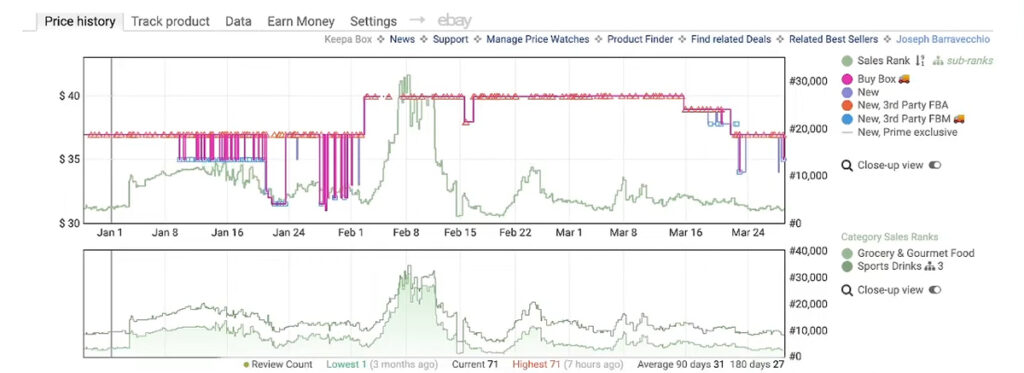
Look at how the seller count changes over time. A listing where new sellers join, sell through, and leave is usually a healthy sign. This signals that the demand for the product is healthy and inventory turns over quickly. At the same time, you want to avoid listings where you can see a correlation between the seller count rising and the price tanking afterwards, which often indicates low profitability and is a major red flag.
Next, check who holds the Buy Box most often. If Amazon itself is on the listing, or one seller dominates the Buy Box percentage, move on. Good listings will have a relatively even Buy Box rotation among many sellers. If you’re an FBM seller, it’s important to see what percentage of the Buy Box shares go to fellow FBM sellers. Try to avoid listings where the algorithm seems to be avoiding FBM, even with competitive or lower prices.
Step 2: Get Your Account and Fulfillment Ready Before You List
Once you’ve sourced a product, make sure your account won’t hurt your Buy Box chances. We covered this earlier, but having a healthy seller account history is a requirement for consistently winning the Featured Offer. If your numbers dip, the impact can hurt your entire business, not just a single product.
For FBA sellers, even though Amazon is handling fulfillment, speed still matters. Prep and label your inventory correctly and ship it ASAP. Products that arrive at Amazon’s warehouses are distributed sooner, which helps you get Buy Box rotation across more regions.
FBM sellers need to focus on reducing handling times, avoiding cancellations, and maintaining perfect tracking data. If you’re able to hit the requirements for Seller Fulfilled Prime, this is also a huge boost to your Featured Offer percentage.
Finally, newer sellers should know that it is very difficult to win the Buy Box when you have no sales history. Over time, this will improve, and once you accumulate some sales and 30-90 days of healthy metrics, you should start to see a natural improvement to your Buy Box share. Just know that in the beginning, it is completely normal to have a low Buy Box percentage.
Step 3: Set a Strong Starting Price and Let a Repricer Handle the Rest
Once you’ve validated your product idea and set up your fulfillment method, your next step is choosing an optimized price. A good rule of thumb is that if you’re using FBA, matching the Buy Box is usually the safest starting point. If you’re FBM, you may need to price slightly below comparable FBA offers to make up for slower delivery speeds.
Setting your initial price is only the beginning, since Amazon prices can change dozens of times a day. For quieter, less competitive listings, manual price updates can work, but for listings with dozens of sellers and potentially hundreds of price changes, this becomes a nightmare to manage.
That’s where repricing software can help. These tools automatically adjust your product price based on your preferences. You can choose to match the Buy Box, undercut it, or rely on AI to calculate an optimal pricing strategy.
For more information on repricers, how they work, and my personal favorites, check out my guide to the 7 Best Amazon Repricers to Help You Win the Buy Box.
Why Sellers Lose the Buy Box (And How to Get It Back)
With how frequently the Buy Box changes hands, it can start to feel random in how Amazon decides on a winner. The reality, though, is that the algorithm reacts to changes in pricing, performance, and inventory all in real time, and even tiny shifts can push your offer out of the top spot.
The good news is that most issues are completely fixable once you understand what they are and how you triggered them.
- Your Pricing is No Longer Competitive
This is the number one reason why most sellers lose the Buy Box. Prices on Amazon change constantly, and new sellers are constantly falling off or jumping onto new listings. Just because your price was competitive one day does not mean that it still is the next. To fix this issue, you need to stay on top of your prices by regularly checking your listings and your competitors’ pricing strategy. If you have the budget, this is where paying for a repricer can be a huge benefit. - Stock Levels Got Too Low (or Hit Zero)
You’d be surprised at the number of sellers that miss this one. If you sell out, you instantly lose the Buy Box. But even low stock can hurt you. When Amazon sees only a few units left, it will often award the Buy Box to someone with more available inventory. Restocking usually solves this issue within a day or two once units check into FBA or your FBM quantity updates. - Performance Metrics Dipped
A late shipment spike, an A-to-Z claim, or a handful of negative reviews can push you out of contention. These issues don’t always remove Buy Box eligibility entirely, but they can make you less competitive. This issue is much more common with new sellers with limited sales history and feedback. Fix any open customer issues, update your handling times, and double-check that your processes are tight.
Most Buy Box losses are temporary. Once you fix the underlying issue, things usually get back on track within 24–72 hours. If you respond to these issues quickly and monitor your listings regularly, you shouldn’t have any issues regaining your Buy Box percentage.
How to Check If You’re Winning the Buy Box
Tracking how often you win the Buy Box gives you a better picture of how often Amazon chooses your offer, and it’s a good way to spot potential issues that could affect your sales. Most sellers make the mistake of only checking on things once something goes wrong, but it’s a good idea to make it a habit to keep up to date with your Buy Box percentage and how things are trending.
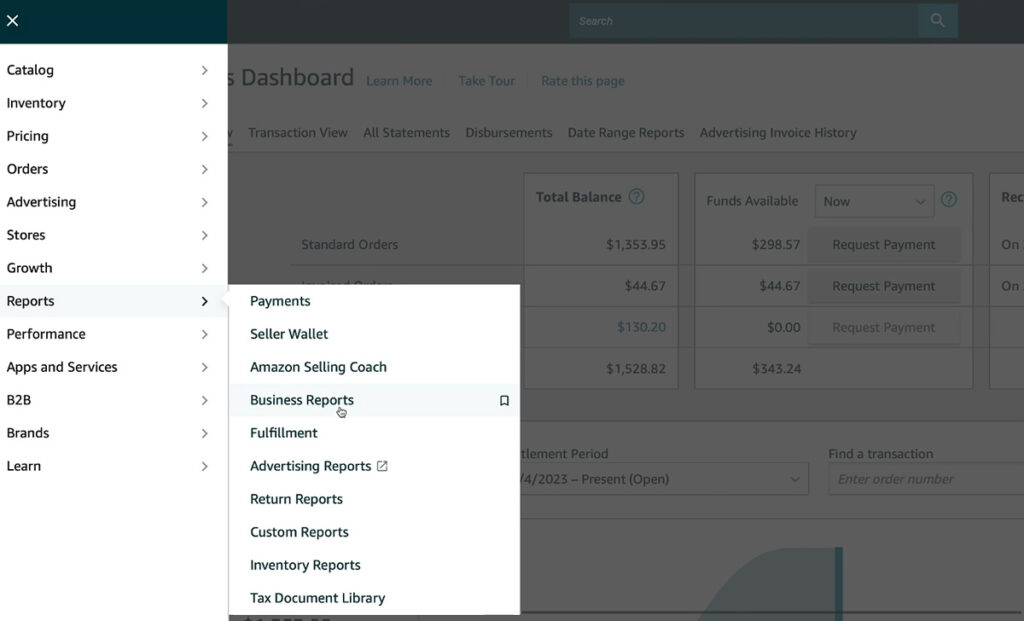
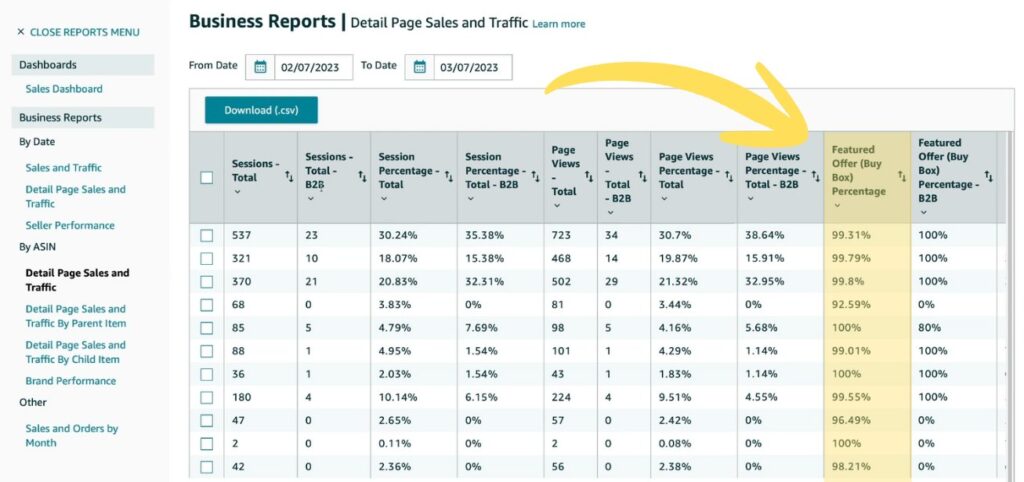
The easiest and best place to start is inside Seller Central. Go to Business Reports and open the Detail Page Sales and Traffic view. From here, you’ll notice that each SKU has a metric called Buy Box Percentage, which tells you how often your product appeared as the Featured Offer during the date range selected. Switch between the 7 and 30-day windows to see whether your percentages are consistent or if things are trending in the wrong direction.
If you manage many SKUs, you might find that Seller Central alone can become a bit slow and time-consuming to work through. This is where a lot of third-party tools can come in handy. Most modern repricers, like BQool or Aura, will give you a Buy Box breakdown for each listing, which can save a lot of time and make things a bit easier to manage.
One thing to remember is that you don’t always need a perfect Buy Box percentage to run a successful business. Arbitrage sellers naturally see fluctuations every day because competition is constantly changing. What matters more is consistency and how your Buy Box share trends over time.
Frequently Asked Questions (FAQs)
How does Amazon decide which seller wins the Buy Box?
Amazon uses an algorithm that ranks sellers in real time to decide who wins the Buy Box. The ranking system compares sellers based on pricing, fulfillment method (FBA vs FBM), account health, inventory location, and stock levels to determine who wins. The most important factors are your product’s price and the fulfillment method you choose, with FBA sellers having a much easier time winning compared to FBM.
What do I need to do to be eligible for the Buy Box on Amazon?
To be eligible for the Buy Box, you need to have a Professional seller account, your product must be in new condition, it must be in stock, and your seller metrics need to be in good standing. This means that you have an Order Defect Rate under 1%, a Late Shipment Rate under 4%, and a valid tracking rate above 95%.
New sellers also need some order history before Amazon will trust them enough to make them eligible.
Do I have to use FBA to win the Buy Box, or can FBM win too?
FBM sellers can win the Buy Box, but FBA has a built-in advantage because Amazon has direct control over shipping, customer service, and delivery speed. This lets FBA sellers win the Buy Box even if they’re priced higher than FBM sellers on the listing. For FBM sellers to compete, they need fast and reliable shipping times, very strong seller metrics, and pricing that is equal to, or lower than, competing FBA offers.
Why am I losing the Buy Box even though I have the lowest price?
Pricing is just one factor Amazon takes into account when deciding on a Buy Box winner, so having the lowest price does not guarantee you’ll win. Amazon still considers your fulfillment method, shipping speed, stock levels, inventory location, and seller metrics. For example, a seller with slow shipping times and poor customer feedback will have a hard time winning the Buy Box even if their product has the best price on a listing.
What does it mean when my listing shows “No Featured Offer” or the Buy Box is missing?
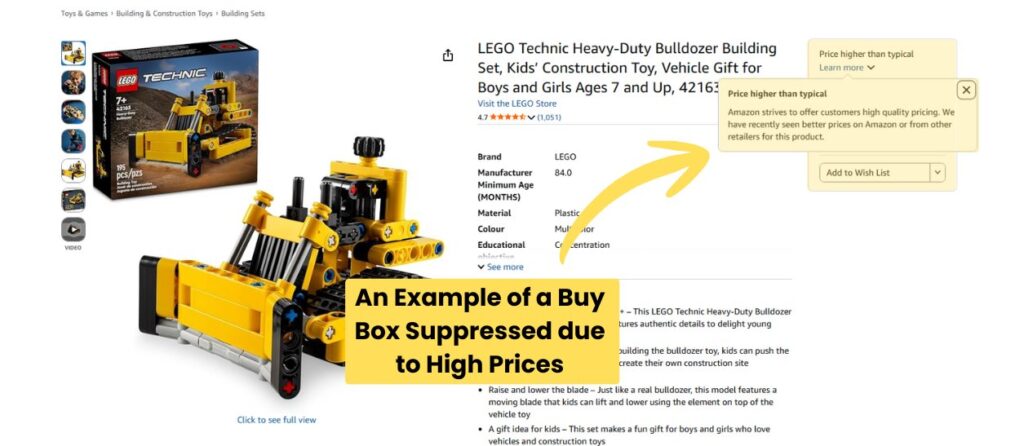
If the Buy Box has been removed from a listing, it means that Amazon doesn’t believe that any seller currently meets the standard for a Featured Offer. This is referred to as the Buy Box being “suppressed.” Customers will only see “See All Buying Options” instead of an Add to Cart button, which can reduce conversion by 70-80%.
Suppression usually happens when all sellers are priced too high, inventory is out of stock, or the listing has quality problems.
How long does it usually take to start winning the Buy Box?
There is no exact time period it takes to start winning the Buy Box, as each listing is different, and more competitive products can take longer. But on average, FBA sellers often see their first Buy Box wins within 7-30 days, depending on competition and pricing. FBM sellers can take longer because Amazon needs to verify their shipping quality and customer service.
If you’re an established seller competing on a new listing, there is no delay, and you will be eligible to win the Buy Box almost immediately.
Your Next Steps to Win the Buy Box More Often
Winning the Buy Box becomes a whole lot easier once you understand how Amazon factors in fulfillment, pricing, inventory levels, and your account health.
Use what you learned here to review your current listings. Make sure your prices are competitive, you’re using a reliable shipping method, and that all of your performance metrics, like Order Defect Rate (ODR), cancellation rate, and return rate, are in good shape. Remember that even small changes often add up to make a big difference, and can be all the difference when it comes to winning the Buy Box.
Related articles:
- How to Start an Amazon FBA Business: A 7-Step Guide
- How to Get Ungated on Amazon: A Step-by-Step Guide
- Amazon Inventory Management: A Complete Guide for 2026

Levi Adler is an experienced Amazon seller, e-commerce specialist, and the founder of Levi’s Toolbox. With over a decade in the trenches selling on Amazon and managing his own Shopify stores, Levi writes from his own experience. Sharing what worked, what flopped, and the strategies he wishes he’d known sooner. When he’s optimizing listings or managing ad campaigns, you’ll find Levi hitting mountain bike trails or hanging out with his two huskies, Emma and Scout.
